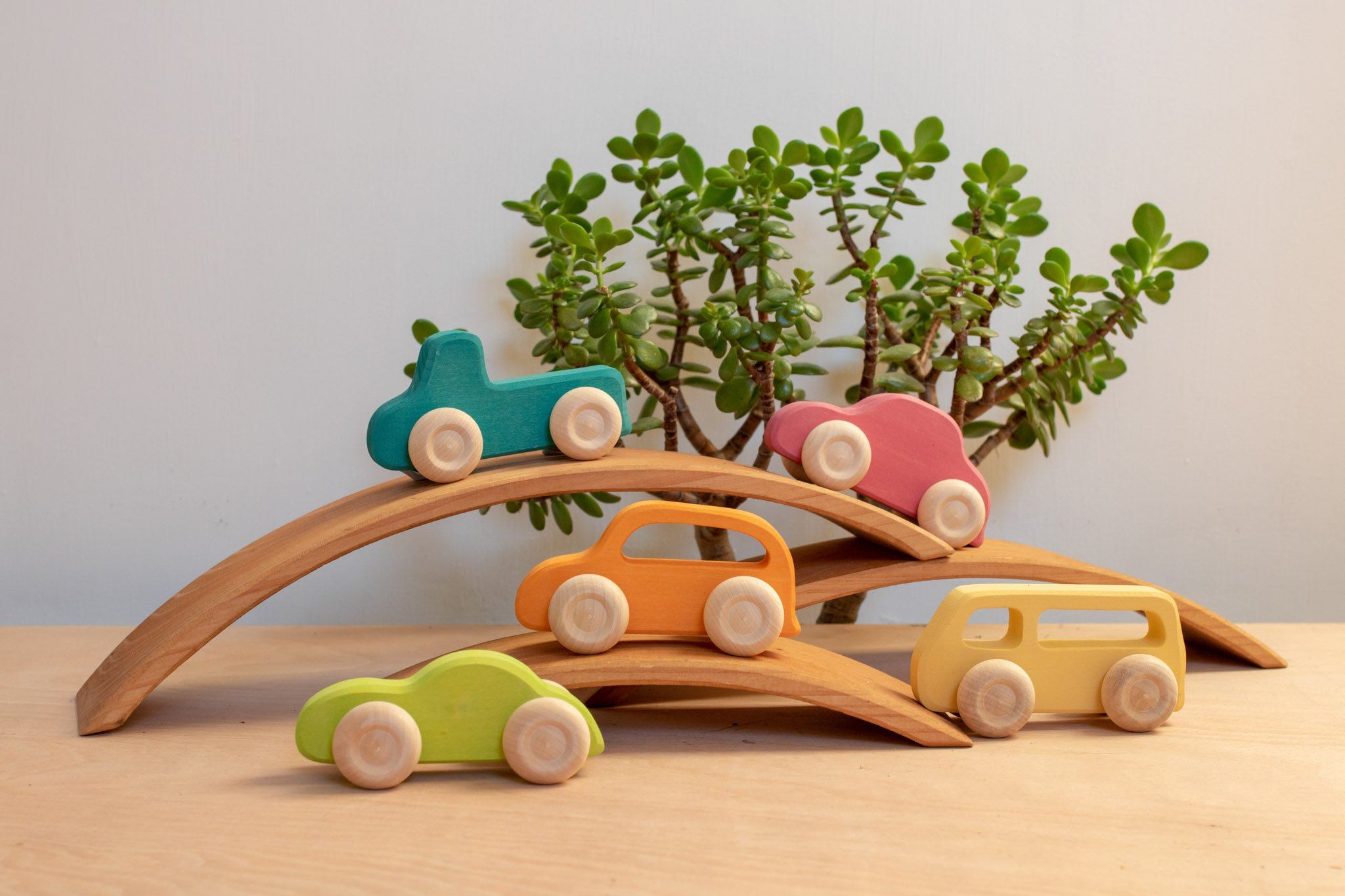
Rotate toys for creativity and focus
Have you ever felt overwhelmed by toy clutter in your home? Ever felt exasperated that your child never seems to play with any of their toys? It doesn’t have to be like this! Simply by learning how to rotate toys effectively, you can reduce clutter and increase your child’s creativity and focus. Read on to find out how:
Contents:
- What is toy rotation?
- What are the benefits of toy rotation?
- How do you decide which toys to rotate?
- What about bigger toys?
- How often should you do it?
- Where do you put the toys you are taking away?
- What if I have only got one of a certain type of toy?
- How many toys do you rotate at a time?
- Should I discuss toy rotation with my child?
- Summary
What is toy rotation?
Toy rotation is a simple solution to a common problem. Most children today have too many toys, and feel overwhelmed by choice. In toy rotation, instead of having all the toys in the house out at once, you divide them into smaller, more manageable groups and switch them around on a regular basis.
What are the benefits of toy rotation?
Apart from the obvious boon of greatly reducing clutter at home, there are a number of benefits of toy rotation for children. When you have all the toys available and accessible at all times, everything gets jumbled up and makes a big mess. There’s a time and a place for messy-play but it’s not an effective strategy for the kind of sustained, independent play that we want our children to engage in and be absorbed by.
Just like us grown-ups, children can find mess chaotic and unsettling, and have trouble focusing on their play in a hectic environment. They bounce around from one thing to another, bamboozled by choice and unable to stay with one toy for very long. They don’t get to practise doing an activity for any length of time as their attention is diverted to whatever has just caught their eye. And even with the best storage for toys at home, getting children to tidy them up at the end of the day becomes a gargantuan task they don’t want any part of.
By rotating a smaller, more thoughtfully-edited selection of toys, children get the chance to focus and play on a deeper level. Other benefits of toy rotating can also include a developed sense of patience and perseverance, heightened creativity as they learn to repurpose toys in different ways, and even an enthusiasm for tidying up since it is no longer such a big job.
Another happy side-effect of toy rotating for toddlers especially, is that you are usually able to declutter your play-space, as you edit and categorise more purposefully.
How do you decide which toys to rotate?
Toy rotating is not a science and in fact any kind of toy rotation usually has a positive effect. If you have some cars out one day and put out a different set of cars the next, the second set (if they haven’t been seen for a while) will be played with as if they were new.
But things get even more interesting when instead of a second set of cars you can provide a different vehicle like a helicopter or a submarine. When thinking about how to categorise toys, a good tip is to think of the different types of toys almost like food groups, and try to ensure that something from each group is available. Here’s a table showing how you might do it (but remember, this needn’t be complicated and if you don’t always manage to get something from each group in, it’s really not the end of the world.)
Toy type |
Week 1 |
Week 2 |
Week 3 |
Week 4 |
Construction |
Wooden blocks |
Duplo |
Train set |
Marble run |
Puzzles & Games |
Matching |
Sorting |
Memory |
Spot the difference |
Loose parts |
Toy loose parts (e.g. Grapat) |
Natural materials |
Manmade materials |
Oversized pieces |
Vehicles |
Cars | Boats |
Diggers & tractors |
Helicopter/aeroplane |
Play figures |
Family | Jungle animals | Woodland animals |
Sea animals |
Soft toys |
Teddy bear |
Fairy |
Mouse |
Dog |
Mark-making |
Crayons |
Chalks |
Paints |
Stamps |
What about the bigger toys, like a play kitchen or a farm?
If a toy is sufficiently open-ended that it can form the basis for all kinds of play, there’s not really any need to rotate it. A three-year-old will probably enjoy having a doll’s house or farm to play with, some figures and a few blocks to extend the scene. The scene will change with her imagination and the scenarios she decides to work with (a play kitchen can be a cafe one day, a home-kitchen the next), so there’s probably not much need to rotate it out. This theory applies to almost any small-world setting (doll’s houses, farms, zoos, city maps) and toys that support role-play like baby buggies, play theatres or tea sets. We wouldn't rush to rotate these types of toys, as they change with your child’s play.
How often should you do it?
You can rotate daily or weekly or even fortnightly. The only rule is that you leave the toys out for long enough that your child has the opportunity to explore their play possibilities fully, but not so long that boredom sets in. A week is usually a good length of time. But some toys merit longer stints than others. For example, a small-world scene like a farm or a city floormat, may provide days of fun, but threading materials could become boring by the afternoon. Observe your child at play and use your judgement to inform your decisions.
Where do you put the toys you are taking away?
This might sound like an odd question, but it’s actually quite important that your child doesn’t have easy access to the toys that are taking a break. We are all for child-friendly, easy-to-use toy storage, but if the toys on rotation are too visible and accessible, you might find they are distracted by them, and will want to get them out or pull them down if you turn your back for five minutes.
Our advice is out of sight, out of mind. Try to find a place that is well away from the toys they are playing with and don’t let them know where it is. A bedroom wardrobe or another cupboard away from view is ideal. If space is tight, simply making sure they are out of reach is a good start.
What if my child is really enjoying playing with a certain toy but it’s been out for a while and it’s time to rotate? If they ask to keep something specifically, we’re inclined to let them. This isn’t a rigid set of rules! And hopefully it means they’re inspired to do something with it. But use your judgement - are they really playing and exploring new possibilities with it, or repeating the same thing over and over? If that’s the case and their explorations seem to have run out of steam, maybe suggest a time limit and agree when a new toy can come out instead.
What if I have only got one of a certain type of toy?
The trick is to come at it, or the activity it represents, from a different angle every time. If for example, you only have one small train track set and your child really enjoys connecting the pieces and building the track, you could think about other ways to provide them with connecting opportunities, whether that’s threading beads or junk modelling with toilet rolls and sticky tape.
If it’s a toy with a number of pieces, as with a set of wooden blocks or a box of cars for example, you can edit the toy in different ways. Provide only the blue blocks one week and the red ones next week. Put out the race cars but not the emergency vehicles. It will require a little more thought at the start but will reap greater rewards as your child becomes more focussed and engaged in their play.
Another option is to bring in toys from your local toy library or swap in toys with a friend who has something you don’t. Moving away from a sense of ownership to a more fluid relationship with toys and how they play with them, is very much in the spirit of rotation.
Source: https://www.onehundredtoys.com
Make Your Business Online By The Best No—Code & No—Plugin Solution In The Market.
30 Day Money-Back Guarantee
Say goodbye to your low online sales rate!